Main Menu
- Home
- Products
- Applications
- Product Support
- Service
- Learn
- Product News
- About Us
- Contact Us

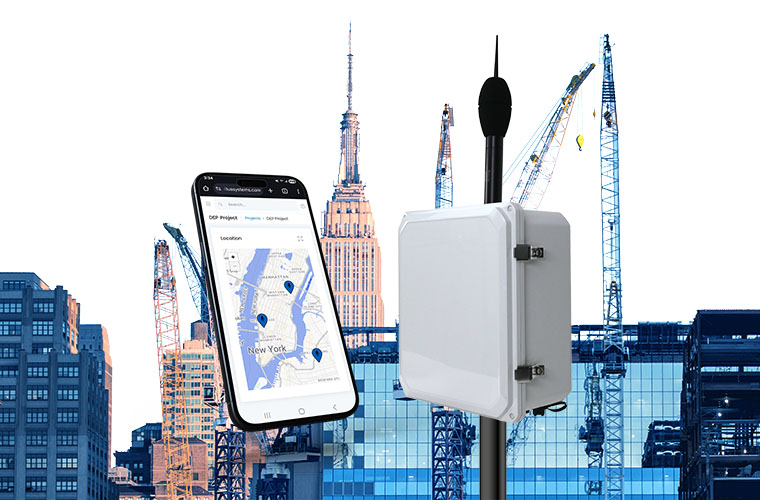 Construction projects throughout New York City face increasingly stringent noise monitoring requirements. For projects requiring an Approved Noise Mitigation Plan (ANMP), selecting a New York City Department of Environmental Protection (NYC DEP) approved noise monitoring system is essential to demonstrating compliance and reducing the risk of project delays, enforcement actions, or work stoppages.
A lower purchase price may not translate into lower project costs. If your monitoring system cannot provide reliable, well-documented, and defensible data, the resulting questions, delays, or additional work can quickly outweigh any initial savings.
The purpose of an ANMP noise monitoring system is not simply to collect sound levels. It is to create a reliable record that demonstrates responsible project management.
Choosing a professional-grade, NYC DEP‑approved monitoring system helps reduce the risk that questions about your monitoring data become questions about your project.
If questions arise about the validity of your monitoring data, you may be asked to perform additional monitoring, provide supporting documentation, or otherwise demonstrate compliance. That can consume valuable time and resources during an active project.
The lowest-priced monitoring option may not provide the lowest overall project cost.
A lower-cost monitoring solution may appear attractive when budgets are tight. However, the initial equipment cost is only one part of the total project risk.
Limited Measurement Confidence
Many lower-cost monitoring systems are designed for general environmental awareness rather than projects where monitoring data may become part of a regulatory record.
Potential concerns include:
When compliance decisions depend on small differences in sound levels, measurement confidence matters.
Incomplete Compliance Documentation
A defensible monitoring program requires more than real-time noise readings.
Consider whether a system provides:
If a noise complaint occurs months after monitoring begins, your project team needs more than a screenshot of a dashboard.
Reliability Challenges in Construction Environments
Construction sites are demanding monitoring locations. Equipment may need to operate continuously through:
A monitoring system must be designed for long-term unattended operation to provide dependable compliance data.
Limited Technical Support
When monitoring is required for regulatory compliance, equipment support matters. Experienced manufacturers provide:
Larson Davis EMS011 uses Class 1 sound level measurement technology to provide a higher level of measurement accuracy and confidence than lower-cost monitoring solutions.
For projects where noise data may be reviewed or challenged, Class 1 performance offers advantages including:
Choosing a NYC DEP‑approved monitoring system means you're using equipment that has been evaluated for the City's construction noise monitoring program. Rather than hoping a lower-cost alternative will satisfy project requirements, you can move forward with confidence that your monitoring system has already met DEP's approval criteria.
When your project depends on accurate, defensible monitoring data, the Larson Davis EMS011 provides the confidence of a NYC DEP‑approved solution built around professional Class 1 sound measurement technology. Designed for continuous unattended operation, the EMS011 helps contractors and consultants document compliance while reducing uncertainty throughout the project.
Key benefits include:
The EMS011 provides the measurement confidence and documentation needed for projects where noise compliance matters.
What noise monitoring systems are approved by NYC DEP?
NYC DEP maintains a list of approved construction noise monitoring devices for applicable projects. The Larson Davis EMS011 is included among the approved systems.
Does NYC DEP require a Class 1 sound level meter?
NYC DEP approval requirements focus on approved monitoring systems and compliance capabilities. Class 1 instrumentation provides additional measurement accuracy and confidence for applications where data may require technical review.
Can I use a low-cost noise monitor for construction compliance?
A low-cost monitor may collect sound level information, but project teams should confirm that any system meets NYC DEP requirements and provides the documentation, reliability, and data quality needed for compliance.
Why is defensible noise data important?
Construction noise records may be reviewed by regulators, consultants, owners, or community stakeholders. Defensible data helps demonstrate that measurements are accurate, reliable, and representative of actual site conditions.